The Do-It-Yourself Book Tour


It’s beenauthor-talk-cape quite a year. Since my pre-launch event last August, I’ve met and read to prospective readers, answered their questions, signed their books, at over two-dozen events and counting. This in-person tour was a totally do-it-myself operation. My small university press produced a beautifully designed book, but couldn’t offer much marketing support. Many new authors–even those with larger publishers–are in the same situation. With that in mind, here are tips to help you plan your own tour:

  • Start on home turf. There’s nothing better than a book launch at your favorite neighborhood bookstore. Mine was at Watchung Booksellers in Montclair, New Jersey, where I had attended many signings, while fantasizing about my own. Your family, friends, and neighbors will rally, buy books–a win-win for you and the store!
  • Expand to wherever you have a network and use it: target familiar bookstores, libraries, festivals, and book clubs. Colleges love having authors speak to students, and will offer an honorarium. Friends might throw you a book party. Mine did. Just ask!
  • Publicize every event in print, online, and social media, on local radio and TV, on podcasts, on Facebook and Amazon book pages, and on your website. Post photos afterwards to maximize buzz.
  • Target subject-related organizations. I have multiple events for a national widow organization in the coming year.
  • Stay within driving distance from home–or not. Since this tour is probably on your own dime, it makes sense to avoid overnights, unless…you can combine a visit to far-afield family with one to their local bookstore. I did and it was well worth it. So cash in your miles. The book is your baby; you spent years raising it. Now give that child the send-off it deserves.

            Final note: There will be setbacks–places you were counting on, that won’t respond. Persist. There are plenty of venues eager to support debut authors. Good luck and enjoy the adventure!


Teach, Write, Teach

It’s spring: blossoms ready to pop dot the forsythia branches, geese glide across my lake, I nurse a cold, and after a long time-off, contemplate the return of my teaching career. While I can’t credit the yellow buds on the bush outside my bedroom window with reviving a role I thought was over, I do believe that the cycle of yearly bloom and dormancy parallels a decade of chance and growth in my work. At the very least, the path from my last teaching gig through a more committed writing life and back again feels natural.

Though I wrote haikus as a teenager, I didn’t really begin to write seriously until I landed my first teaching job at the University of Texas at Austin. I worked for the drama department carrying a mind-numbing sixteen class a week load, and after a mere six weeks, understood that if I was going to keep my sanity, I’d better find something creative to do. I had been obsessed with Edna St. Vincent Millay for years, followed her to Vassar, and decided to write about her in a one-person play. I was fixated on creating an acting vehicle, not on writing as an end in itself. But in those days I didn’t really know who I was. I look back now and see a strong writing thread tying acting, teaching, travel and my social life together. In ’79 I came to New York City to make it as an actress, armed with a second one-person play, and went on to write two more. All the while, I taught: at conservatories, tiny acting schools, respected universities, and privately, when the occasional student wanted coaching.

Even after I had put acting behind me, writing and teaching continued to compete for my limited wife-mommy-artist time. While running a non-profit for writers, that I ruefully named “Tunnel Vision Writers’ Project,” and leading multiple workshops for its membership, I grew frustrated; I couldn’t summon enough tunnel vision to do my own work, and decided to walk away from teaching for what I thought would be forever.
That was in 2007. A decade later, my memoir has brought that role back into my life, as organically as it had left. Last summer, before the book was out, a friend of a friend asked if I would be interested in teaching a workshop for memoirists. She knew other people, who she thought would be interested. Though up until that moment, I hadn’t given teaching again any thought, I knew right away that I wanted to do it. “Sure, maybe in the spring,” I said. After the book launch and a flurry of events, I checked back to see if she was serious and indeed she was. Last month I met with five smart, talented, accomplished women writers for two marathon workshop sessions, at the end of which, they all agreed to continue. The happiest result: I have re-discovered my love for teaching. The time off had honed and solidified what I could give students–my experience, common sense and a bit of hard-won wisdom–and re-fueled my depleted energies. I am certain that I’m a better teacher now than I was 10 years ago, and I’m eager to see where that role takes me.

A week later, I stood behind my book station at the Albany Barnes & Noble’s Local Author Day, trying not to feel “less than” the couple of “Big 5” authors at the table next to mine, when a potential reader approached and asked if I could help him ready his own memoir for publication. He hadn’t read my book yet, and I doubted if he knew that I was a teacher. I told him as much, and said I’d be glad to help him. He bought the book, and the next day contacted me through my website. I dug out my old rate forms for the coaching services I had abandoned a decade earlier, adjusted the fees upward–after all, I was a published author now–and sent the information off to him. We will start working together next week.

None of this would have happened if I hadn’t walked away from teaching, focused on my on work, published, and then emanated my readiness, once again, to give what I had learned to other writers. Teaching led me to writing; writing led me back to teaching. Sometimes if you release a pursuit you love, because you have to, because there are other equally pressing loves, that skill-purpose returns to you. At the right time it bursts forth like a spring flower, bright and beautiful: a full (read satisfying) circle.

Then again, all of this teaching makes me itch to start my second book. Let the cycle continue!

Reader Response

Much as I have loved my book launch events this fall, some of the most deeply satisfying moments occurred while I was sitting in front of my computer reading an email, an Amazon review, or a Facebook message from a reader who found the book moving or helpful or powerful or all-of-the-above. There’s nothing quite like knowing that I reached someone out in the world, whom I haven’t met, and touched them with my story. Unlike my bookstore appearances, in this circumstance I am not selling the memoir by sharing well-chosen excerpts from it, or fielding questions from readers who might buy my book. In this case, I don’t have to do a thing, except receive my readers’ responses in the spirit in which they are given: generously, humbly, enthusiastically. In these encounters, there is nothing between us, except the work itself. It’s the bridge and conduit to a pure author-reader connection. After years of solitary writing and re-writing, I’m enormously gratified to know that readers have embraced Dying in Dubai.

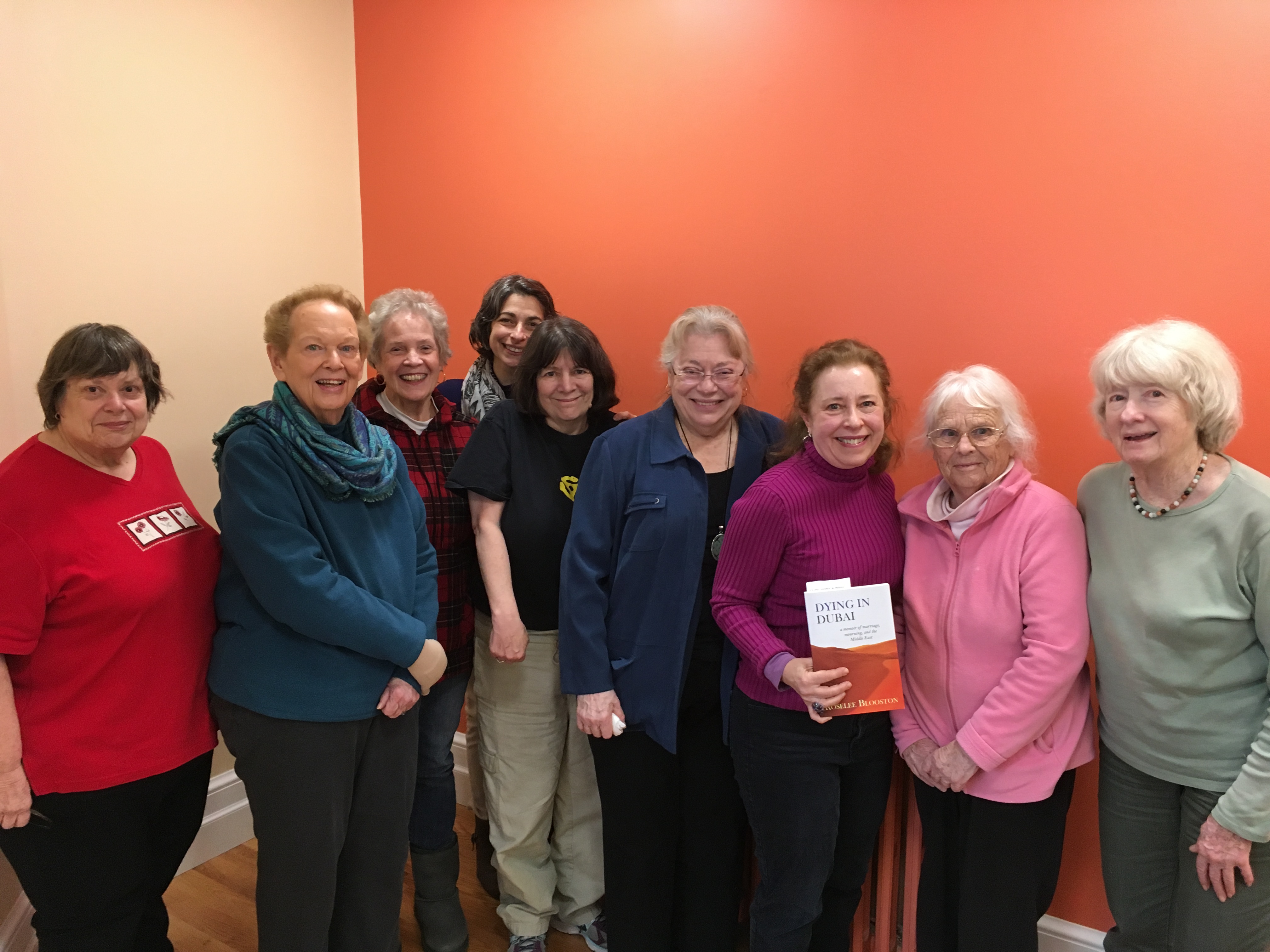
This is not to say that my live experiences with book groups have been in any way lesser. Not at all. They’re just different. Whether via Face Time—I chatted with a Cape Cod group this way; they passed the phone around their circle and tackled every one of my website’s Reader’s Guide questions—or in person at my hometown public library’s book group, rhl-book-group12-13-16-2the gatherings are fun, intimate and informative. The fact that some or all of the group members know me (or think they do) colors their responses and sometimes skews the discussion towards the personal as opposed to the literary. All good. Readers who know me either don’t want to go near the delicate aspects of my story—understandably, relatives didn’t want to talk about the infidelity thread*—or they want to go directly at it. I opened the door, and they walked through it, or walked around it!

At each meeting, there are the expected questions readers ask:

  • Why did you write the book? (Because I had to.)
  • Was it hard to relive your experience on the page? (Yes and no. Very early on, it became more a matter of craft than of PTSD.)
  • Was it cathartic? (Yes, but only once the book was published.)
  • What did your family think? (They liked it, didn’t read it, or see above*)
  • What’s next for you? (Another book)

And the surprising ones:

  • Do you think your husband would have approved of the book? (Yes, I’m sure he would have. Jerry was my biggest fan.)
  • Are you dating again? (No, but I’m open…)

The most surprising reaction has been that of my two closest friends, both of whom have known me for decades. Both have struggled with absorbing my experience in book form, perhaps because they were part of it; it seems to be as emotional for them to read as it was for me to write. I realize that they are also dealing with revelations in the memoir that I didn’t share with them, close as we were. This was a conscious choice on my part. I wanted everything that had happened to me to exist nakedly on the page and didn’t want to risk diluting the impact by the kind of processing girlfriends do. This slowed them down considerably. One still hasn’t finished reading….

In contrast, I’ve heard from many readers that “it was a page-turner,” “couldn’t put it down,” “wanted to finish it more than I wanted to eat supper.” (That one made me laugh!) There are widows who loved it, and married women, for whom my story is their worst nightmare, who were glad to read the upbeat ending. A number of readers said that they felt like they “knew my husband,” and recognized the deep connection between us. I was happy to know that I got my major point about the marriage across. Many who spoke to me remarked how much they loved Wali’s “big as the universe” metaphor for the grieving process, and some said that they passed it along to friends going through loss. Glad to hear it.

As 2016 winds down, I welcome more comments from anyone who reads my book. I’m keeping a book of reader responses, which I will treasure long into the future. I welcome yours, and look forward to the events and book group discussions I have scheduled for 2017. Bring it on!

Happy Reading and Happy New Year to all!


Shelved

October has been a whirlwind of bookstore launches, after-parties, interviews, reviews, and appreciation via email, phone and old-fashioned note cards from family, friends, and strangers, and best of all, oceans of love. As wonderful as this experience has been, there was one small public moment and one big private one that were most powerful for me, distilling it on both a macro and a micro scale.

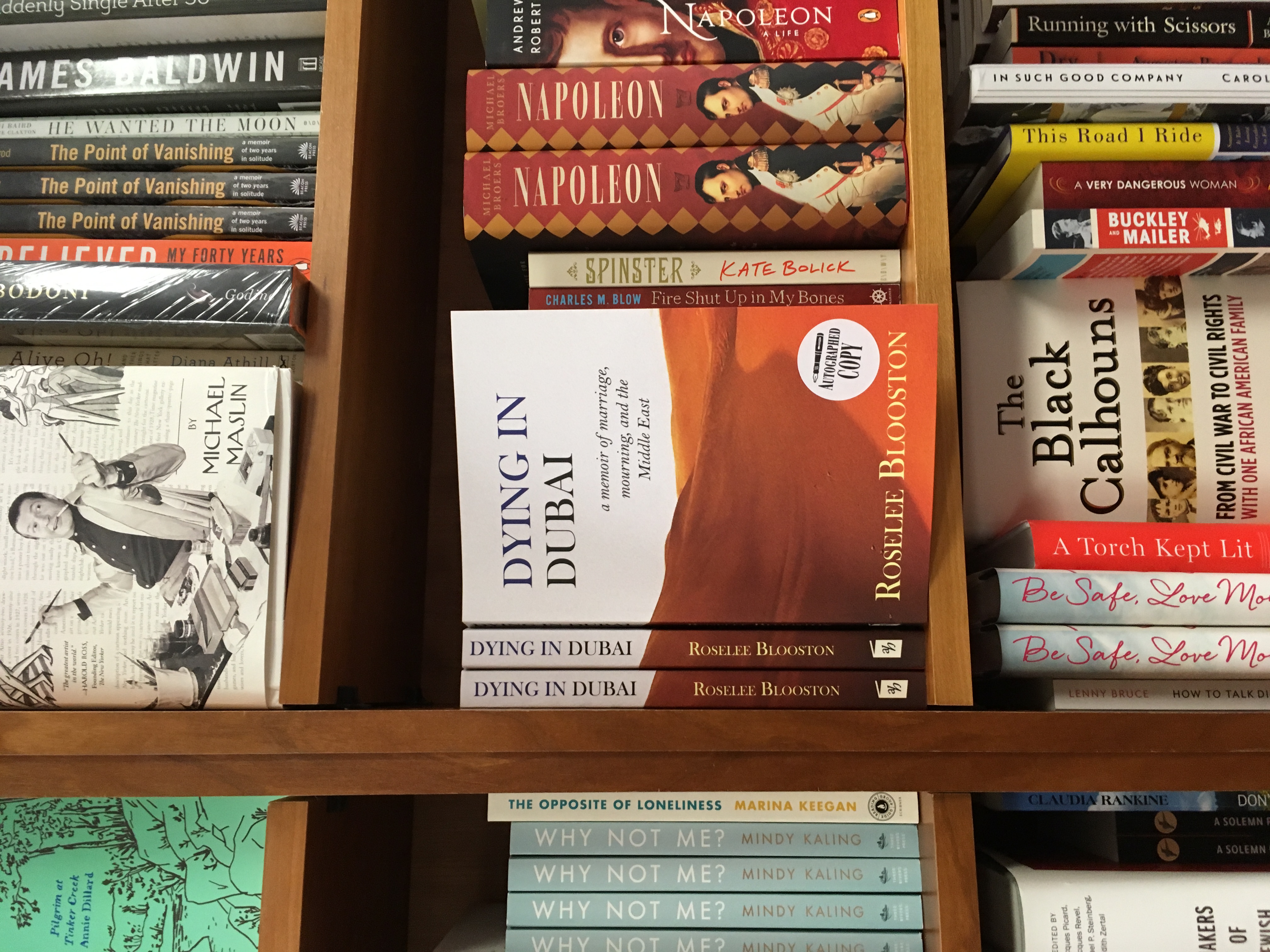
After signing extra copies of Dying in Dubai for my home bookstore, Oblong Books & Music, to sell post-event, I waited a few days to return. When I did, I made a beeline for the memoir section. There it was, the most satisfying accomplishment of all: my book on a bookstore shelf, cover face out, adorned with a silver “autographed copy” seal, propped against a few more, Napoleon to its right, Mindy Kaling on the left, Michael Maslin above, The Black Calhouns below. If you’ve been reading my previous blog posts, you will recognize the continuing theme: my manifest arrival in the company of other authors. The simple fact that my first book sat on the shelf of a bookstore made the achievement concrete. I saw it. I felt it, and  I was grateful for it.

That was the macro (public) moment.

The micro (private) one was this: the day after my official book launch in Montclair, New Jersey–a sold-out SRO event with an audience reflecting our whole family history and mine before Jerry; even a grad school friend showed up–I entered my Hudson Valley home, tired but satisfied, and noticed that the copy of Dying in Dubai I had propped weeks before on a high shelf in my living room for all to see, face out (as in the bookstore photo), was on the floor. It had been standing there for weeks, as had a few other books I displayed similarly, which stayed put. Books didn’t fall off my shelves.

Nothing else in the room was amiss. I shrugged and went to my bedroom to unpack. About 15 minutes later, I reentered the living room. Dying in Dubai was on the floor again–in exactly the same place. I noticed that it was a few feet from the bookshelf, as if it had been thrown.

I should say here that I don’t believe in ghosts, I don’t talk to them, but I do believe that we are all made of energy that changes, yet doesn’t leave. I looked up, and said out loud, “Jerry? Okay, okay, I hear you.” Then I picked up the book and placed it back on the shelf. It hasn’t moved since.

I had the distinct feeling that the book fell the first time, while I was in our old hometown reading from it to our community. Later, I wondered if my husband was sending me a specific message, that he was with me regardless, because I had forgotten to go to his grave; Jerry was buried in Montclair. I had every intention of paying my respects while I was in town, but by the time the event was over and my son and I had our brunch debrief at our favorite restaurant the next morning, all I wanted to do was go home. And I did.

Reading this, the skeptics among you might think that this line of thinking is a bit crazy. I agree, but I can’t dismiss what happened. It was as real and as important as seeing my memoir on the bookstore shelf. Jerry’s energy is out there, whether between the covers of my book or in my new home. My beloved husband is in the world. Still.

Author

It’s two weeks until my book launch and I feel tremendous anticipation about what is certainly a defining moment in my life—very much like the two other days in my past when my public identity changed: my wedding day at the bus stop where Jerry and I met, when I became a wife, and the day, almost exactly three years later, when I gave birth to our son, Oliver, and became a mother. The launch on October 1st in our old hometown, Montclair, New Jersey, marks the moment when my status as a writer transforms permanently into that of “author.” Though I’ve had stories, essays and articles published in journals, magazines and anthologies, as well as plays professionally produced—the theatrical equivalent of publication—the publication of my memoir brings me to an entirely different level of achievement. An author is a writer who has published a book, and with the publication of DYING IN DUBAI, I have met the definition.

I remind myself how momentous and satisfying the launch event will be, as I tick down my list of To Dos: check in with my publicist, contact libraries and bookstores to schedule more events, organize the receptions, plan my readings and remarks, test pens, practice my signature, and answer the all-important question: What am I going to wear? At least once a day, I have to stop and take a conscious deep breath, lest I become the author version of Bridezilla. I tell myself, it will work out fine—you deserve it—now enjoy it.

On a particularly trying day, when I wondered how I was going to get from here to there— I was so frazzled that I actually spelled my first name “Rosalie” in an email signature—I stumbled onto the website for my local Rhinebeck bookstore, Oblong Books & Music (near my new home in the Hudson Valley), where I will have a second launch on October 6th, I had meant to hit another link, but rather than immediately switch sites, I found myself mesmerized by their home-page sliders of upcoming events: Man Booker Prize finalist, Emma Donoghue, Oprah’s Super Soul Sunday fav, Elizabeth Lesser, Bright Lights, Big City legend, Jay McInerney…and me, Roselee Blooston. I had to watch the loop of their faces and names, before and after mine, three times, before I could begin to absorb its import. I wasn’t delusional. I knew my career existed on a far more modest plane than these heavyweights, but even so, each slider was the same size and style; in this simple, direct presentation, we were equals—peers—because we had something fundamental in common: we were all published authors promoting our new books.

I let out a sigh and sat back nodding. It felt good.

Present and Past at Pre-Launch

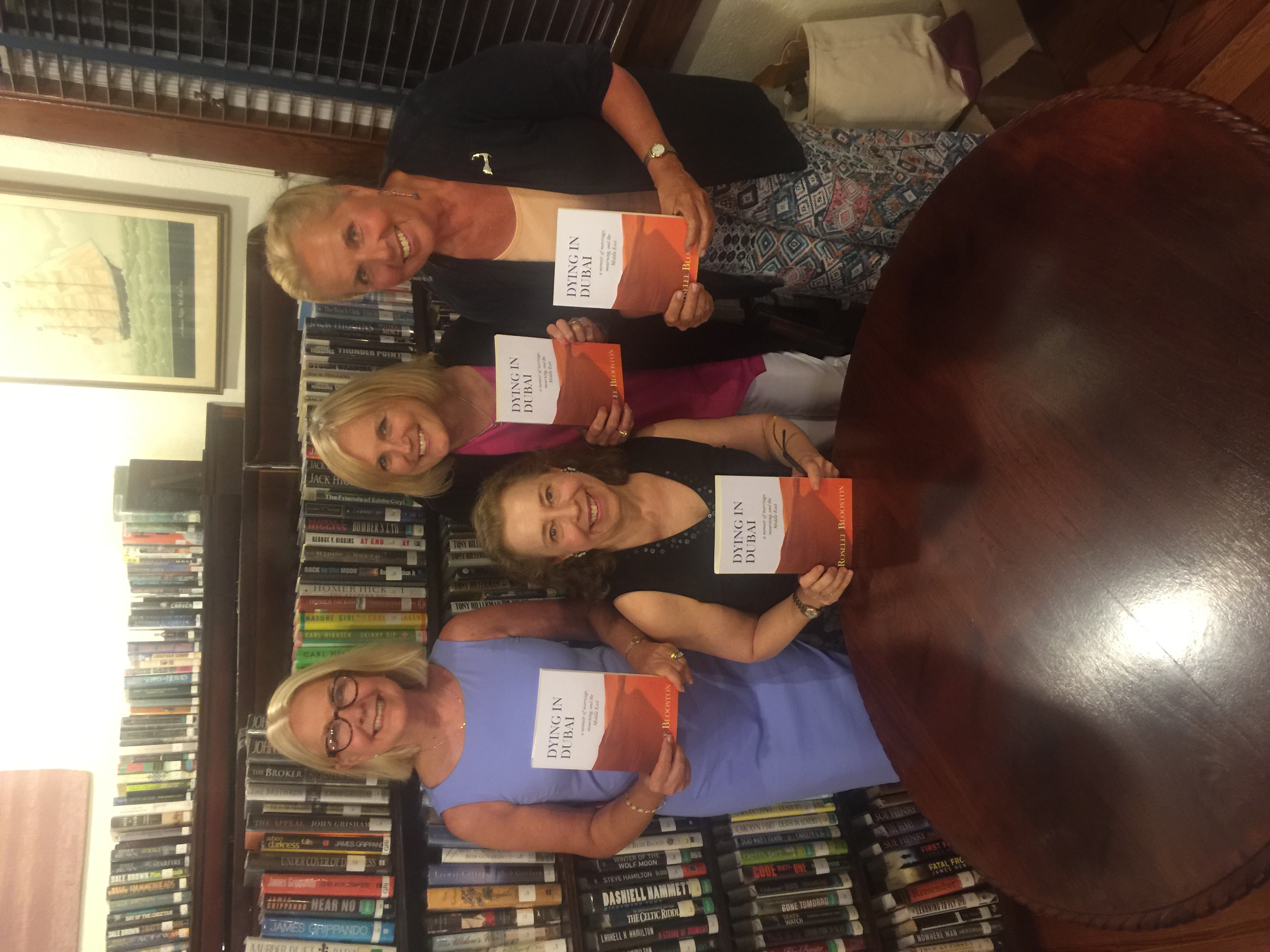
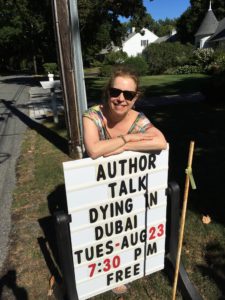
When my good friend and Vassar classmate, Robyn Travers, offered to pitch an Author Talk for me at the Jacob Sears Memorial Library, her local Cape Cod branch, neither of us realized that its event coordinator was Janet Robertson, another Vassar ’73 grad. They both did an incredible job publicizing the August 23rd event, which—with my publisher’s blessing, since it was 6 weeks before my official Oct 1 launch—included a reading and signing. There’s nothing better than the power of old school ties!

And that was only the first of the remarkable associations that manifested that evening. As I waited to begin my talk, I sat to the side of the podium (which I didn’t use, since I prefer to move, and because I’m so short, I would have looked like a literal “talking head” behind it), and overheard a mother and daughter talking. I had put postcards about the book on each seat. The young woman picked up one, turned it over, and remarked, “Mom, this is from my school!” I introduced myself, and asked if she attended Loyola University Maryland, home of Apprentice House Press, my publishing house. The answer was yes—she was a senior there—but she had come, because she had just spent 2 months in Dubai. Ah, synchronicity!

A few minutes later, I was surprised and delighted by Janet’s introduction. She was incredibly thorough, going as far back as my one-person plays. When she mentioned “The Queen’s in the Kitchen,” and my long ago status as a professional look-alike, I spontaneously did the wave. The audience laughed and I was over the hump before I’d spoken a word. Considering the subject matter of my memoir, I had been concerned that the talk would be too heavy. No worries. Between QE2 and the romance and fun of my bus stop wedding, there was plenty of levity. In any talk, especially one about an emotional subject, it’s important to make ‘em laugh, make ‘em cry. I did both.

The tears weren’t all sorrow; some were sweet. At the end of the talk, I read a Cape Cod scene featuring my Vassar friends and fellow drama majors, including Joan Bogden, who had given me her professional coaching advice gratis that very afternoon. Together the 3 of us had visited the Monomoy Theatre in Chatham, MA, where I had done 2 seasons of summer stock. Before the reading, I had given Joan and Robyn inscribed copies and told them not to look at Part Two. This was why. They didn’t know they were in it. I had managed to hold myself together, when I spoke of losing my husband, but seeing Robyn and Joan tear up while I read about our little jaunt, I almost lost it.

Afterwards, a woman approached the table where I was signing books, handed me her copy, and asked when I had performed at the Monomoy and in what shows. I told her, rattling off 5 or 6 plays. “I saw them all,” she said, “and I remember you.” I was moved and humbled. Actors and writers don’t always know their impact. When a moment like this happens, it is a gift. It’s not often that present and past merge so seamlessly. Now I can trust that, like my performances, my book will reach and touch strangers over time. The very point of writing it.

The Comma Queen’s Ruler

Many readers don’t realize what goes into the editing of a book. Let me clue you in. DYING IN DUBAI has gone through numerous drafts—at least 14 by my latest count: some, which I edited myself, and some, which an outside editor reviewed.

The first editors to comment were developmental editors. Their job is to look broadly at character, plot, story arc, themes. Like novels, memoirs must satisfy in all of these categories. When I handed in my drafts, I was nervous about what these editors might say, and also eager to address their concerns. That doesn’t mean I always took their advice; not because they were necessarily wrong—usually they had valid points—but because, ultimately, it was my book, and I was the final editor. I needed to trust my gut when making a choice between their suggestions and my own sense of what had to be said, or eliminated. Now I am very grateful for that process; it made the book better.

The other type of editor is a copyeditor. These essential professionals go over the writing word by word and line by line to find mistakes in spelling, grammar, punctuation, and sometimes in formatting, i.e. spaces between sentences and words. I hired a very competent woman to line edit the memoir before I turned it into my publisher, who would then layout the pages in book form. My small university press didn’t have the staff to copyedit, and recommended that my copyeditor and I follow the Chicago Manual of Style as a guide.

When I turned that draft into the publisher, I thought I was done. But no. What followed once I saw the layout were another 4 drafts of back and forth between me and the layout designer about spacing, font size and style, headers and footers, blank pages, and the bane of my existence: the Oxford comma. That’s the comma before “and” in a series of three or more, that AP style avoids to save space and Chicago embraces. I had been trained not to use it, but as soon as I chose, for design reasons, to add a comma before “and” in the cover subtitle— a memoir of marriage, mourning, and the Middle East—I had to go back through the entire manuscript to be consistent (most important, according to the publisher) and to add countless Oxford commas, making only a few exceptions for reasons of spacing. I won’t bore you with em dashes (—), ellipses or italics. Suffice it to say, the lists of corrections that I sent the designer were long and detailed.

Midway through this grueling process, I attended a reading at my favorite local bookstore, Oblong Books & Music in Rhinebeck, New York by Mary Norris, famed copyeditor of the New Yorker, and author of Between You & Me, Confessions of a Comma Queen. During the Q & A, I asked if she and the copyeditor of her publisher, W.W. Norton, had had any disagreements about style choices. She said yes, but that they had worked them out. Then she volunteered that the hard cover version of the book had been “riddled with errors,” and that the paperback version, which we were there to celebrate, still had two. I was shocked and dismayed. If the most trusted copyeditor of the most polished magazine couldn’t perfect her book, what hope was there for me?

After the talk, I handed Ms. Norris my newly purchased copy of her book to sign, telling her that, I was both heartened and horrified to hear of her experience, because I was about to have my own first book published.

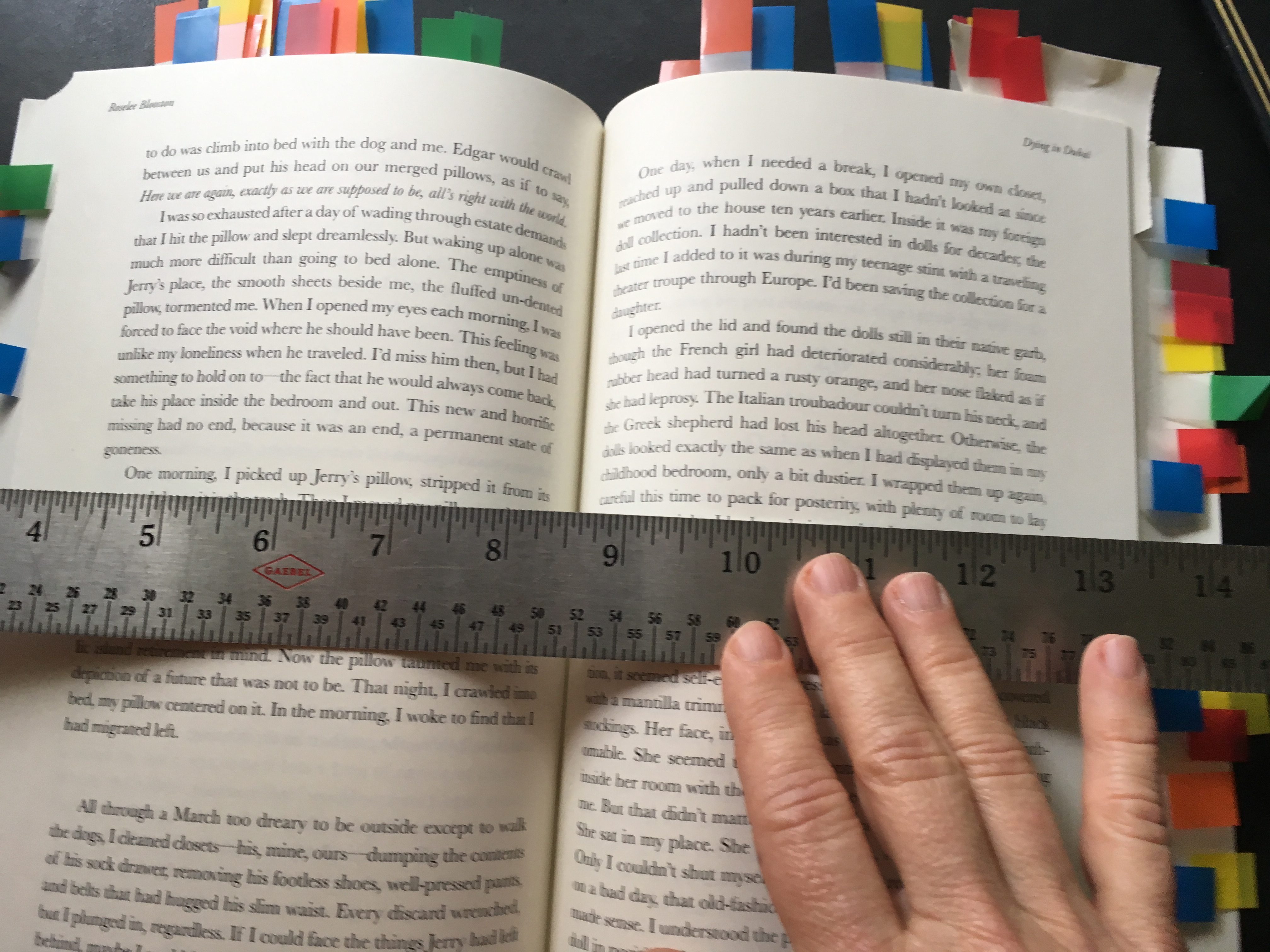
She smiled her kind, wise smile and said, “No one is perfect. Just do the best you can.” Then she gave me a tip: “take a ruler, place it under each line so as not to let your eyes race ahead, and go through the manuscript that way at least once.”

I thanked her, took her instruction as gospel—she had forty years of copyediting experience to my one—and have employed the ruler three times. Most recently, during my final pass, after
Blog 4 photo

going through the Advance Review Copy (see my previous blog post), making my last changes, and then receiving a final PDF from the publisher for me to sign off on, I discovered that not everything was in my control. Yes, they had made all the changes I asked for, but in so doing had triggered a bizarre software malfunction rendering the layout a mess! I had a morning-long panic attack, took a deep breath, texted my publisher to alert him about the problem, and am now awaiting yet another PDF to review: draft number 15.

So I ask only one thing of you, dear Reader: if you find an error in my book, remember that it puts me in good company.
Book in Hand

The ARCs have arrived!

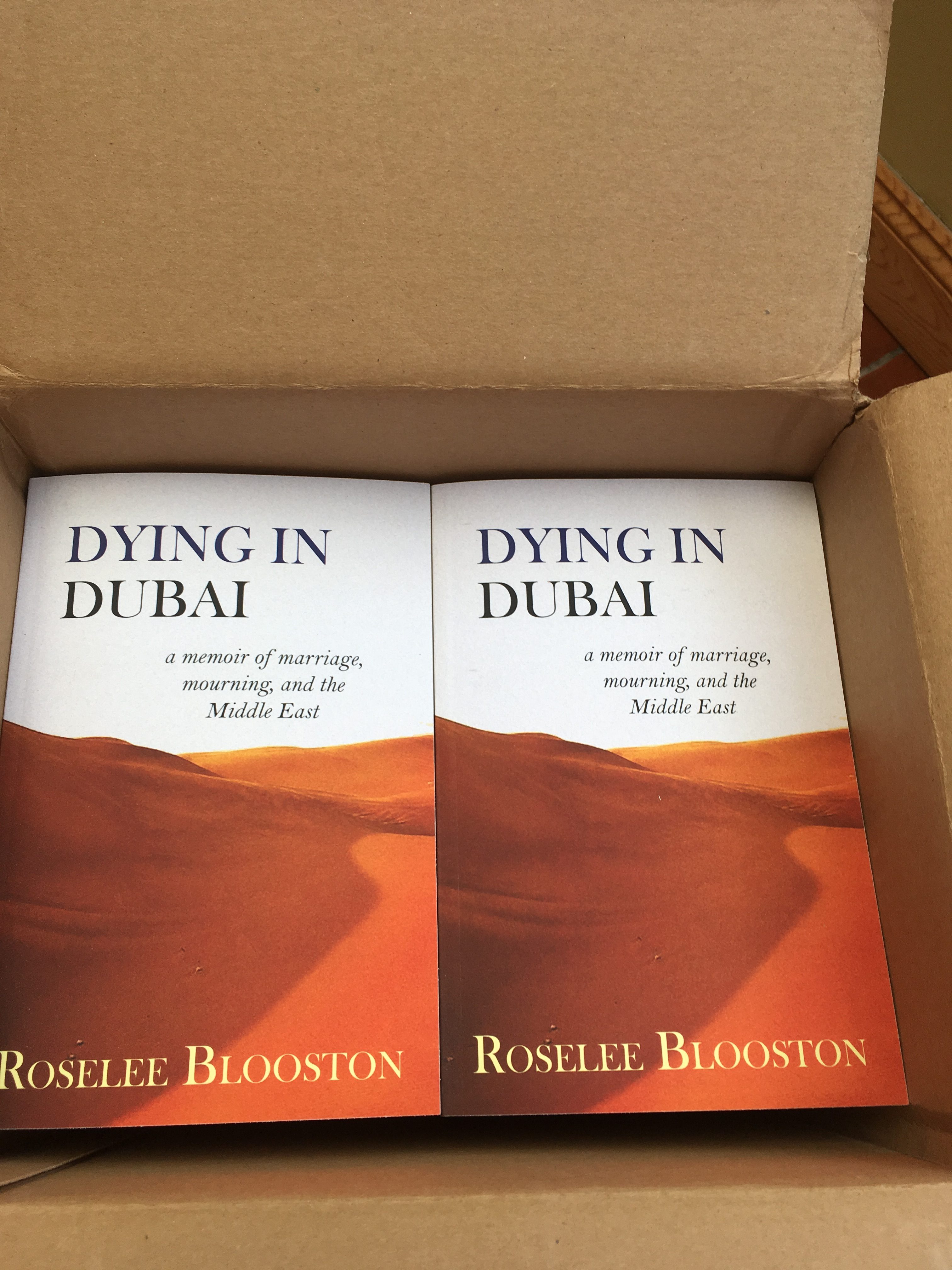
Last week, when I contemplated writing this blog entry, I intended to title it, “Obstacles and Opportunities.” I often start with a title. My plays and my memoir, DYING IN DUBAI, began that way. Then two days ago, a box arrived, containing the Advance Review Copies of my memoir—ARCs, as they are known in the industry—and since that moment, and the one mere seconds after, when I sliced through tape and ripped open the cardboard top, to behold two stacks of “the book,” all thoughts of the eight plus years it took to get here, flew from my mind. In that moment, there was only the book in hand.

I stood alone, in my sunroom, staring down at the concrete manifestation of my long-awaited dream. The story of my grief and transformation that I had known from the outset could touch and help readers I would never meet, was now a reality, and I was both proud and stunned. For what felt like a long time, but may have been only a minute, I didn’t move. I drank in the cover, which of course I had seen on my screen many times, its three-dimensionality far superior to the flat image. Rarely is an imagined vision perfectly expressed. This was.

Gingerly, I lifted out a copy, careful not to bend the edges. I marveled at the size and weighed it, using my hand as scale. Solid. I inhaled the “new book” smell of freshly cut pages. I turned it over and admired the way the front cover’s sand and sky wrapped around to the back and how the blurbs, description, and my photo and bio all fit exactly as I had wished. Tentatively, at arms length, I flipped through the pages, congratulating my early insistence on cream stock—so much softer and easier on the eye than white—but I did not read. I still haven’t. I’m saving that experience for next week, or the week after. My publisher doesn’t need final changes until the end of July. Plenty of time to get used to the idea, to the fact, to the artifact of my labors stored in my study, and in that box. I have read thousands of books in my lifetime; next, I will read my own.

What do I think now about the obstacles that littered my path, but ultimately did not deter me: foremost among them, a two-year agent search and the nine months spent with one whose interest turned out to be tepid? I had thought that having an agent was the golden ticket, which was why I spent so long trying to land one, but learned instead that it’s better to have no agent than a bad agent, who would take 15% of any contract, even one I initiated. Weeks before I fired mine, sure that I would, I drew up a list of independent publishers I could approach without an agent. After a summer of re-grouping, I began again, on my own, and got an offer from the first publisher I applied to: a small, non-profit, university press. My goal had been to see the book published, not to self-publish. Years of solo performing, which sometimes involved self-producing, taught me that I needed the undeniable legitimacy of a curated process. The publisher said yes, they would be delighted to publish my memoir, and that was all the validation I needed. The agent had been a necessary obstacle, without which I would not have made my own opportunity.

Here I sit, at my desk, an ARC next to my computer, a solid, handsome volume containing my life and my work. Decades of performing gave me many euphoric moments, but life in the theater is all ephemera—by definition, it cannot last. The book exists, on its own, without me, and it could exist long after me. A writer friend pointed out that our books could end up in a yard sale that our grandchildren might come across someday. He meant it as a wonder, a legacy, a gratifying prospect. I agree.

So it is with joy and deep satisfaction, that finally, I hold my book in my hand.

Birth & Rebirth

Why does embarking on a new chapter in my writing life feel like both a birth and a rebirth? Part of the answer is obvious: there is a lot of labor involved, a lot of figurative blood, and real sweat and tears. When I began writing, I was a child creating illustrated poetry books, which were a secondary outlet for my ever-present need to express myself. Those first efforts rhymed. Later, as a 7th grader, I turned to haiku and got my first accolades: an Honorable Mention in the national Junior Scholastic writing contest. But acting was my true love, and after college, frustrated with my university teaching job, and longing to be on stage, I wrote my first one-person play, The Phrase in Air, on my idol, Edna St. Vincent Millay. I found this so fulfilling that I went on to write four more solo vehicles, which garnered more attention, including national and international bookings, and a glowing review in Variety, not to mention the resolution of my fears about becoming a mother (dissected in Mad Moms) with the birth of my son. But none of those efforts resulted in a sustaining professional career. So I let the theater go. I let that phase of my life die, mourned it, and moved on.

Hence, my rebirth—by definition a partial revisiting of an earlier incarnation—I was still a writer, though no longer a playwright. This rebirth required greater loss than a disappointing acting career. When my husband died in 2008, I knew that part of the way through my grief was through writing. I also knew that I would be a different person, an After Jerry version of myself, reborn as a woman alone, and as a memoirist.

I won’t catalogue the blood, sweat and tears here. Dying in Dubai does that. I will say that I believe all writing is in some sense reinvention, whether an immersion in a new genre or a means to a new life. Circumstance told me what form my writing had to take to tell the story of my loss and transformation. In memoir, I had to drop “characters” and be myself, the naked role I had in some sense been avoiding in my plays. I had to start over, completely. My memoir is both the vehicle for and document of that journey.

Have you experienced such a birth and rebirth through your writing? If so, I’d love to hear about it.

Welcome to my blog!

In the next few months I’ll be giving you a glimpse of the inner workings of my journey to and through the publication of my first book, DYING IN DUBAI, a memoir of marriage, mourning, and the Middle East. This is, to say the least, an exciting time for me, and one of deep satisfaction. I still can’t quite believe that I’m here, anticipating the launch of a book. It feels like both a birth and a re-birth. More on that later…For now I’ll simply say that there is nothing better than achieving a major goal, especially when the road has been long, rutted, and at times, blocked. In retrospect—sometimes the only clear view—what looked like detours actually provided the impetus to make the dream manifest. Stay tuned for details of those detours/opportunities. I can’t wait to share them with you and to hear your own. Meanwhile, keep reading, writing, and following your passions!

My very best,
Roselee