Reader Response

Much as I have loved my book launch events this fall, some of the most deeply satisfying moments occurred while I was sitting in front of my computer reading an email, an Amazon review, or a Facebook message from a reader who found the book moving or helpful or powerful or all-of-the-above. There’s nothing quite like knowing that I reached someone out in the world, whom I haven’t met, and touched them with my story. Unlike my bookstore appearances, in this circumstance I am not selling the memoir by sharing well-chosen excerpts from it, or fielding questions from readers who might buy my book. In this case, I don’t have to do a thing, except receive my readers’ responses in the spirit in which they are given: generously, humbly, enthusiastically. In these encounters, there is nothing between us, except the work itself. It’s the bridge and conduit to a pure author-reader connection. After years of solitary writing and re-writing, I’m enormously gratified to know that readers have embraced Dying in Dubai.

This is not to say that my live experiences with book groups have been in any way lesser. Not at all. They’re just different. Whether via Face Time—I chatted with a Cape Cod group this way; they passed the phone around their circle and tackled every one of my website’s Reader’s Guide questions—or in person at my hometown public library’s book group, rhl-book-group12-13-16-2the gatherings are fun, intimate and informative. The fact that some or all of the group members know me (or think they do) colors their responses and sometimes skews the discussion towards the personal as opposed to the literary. All good. Readers who know me either don’t want to go near the delicate aspects of my story—understandably, relatives didn’t want to talk about the infidelity thread*—or they want to go directly at it. I opened the door, and they walked through it, or walked around it!
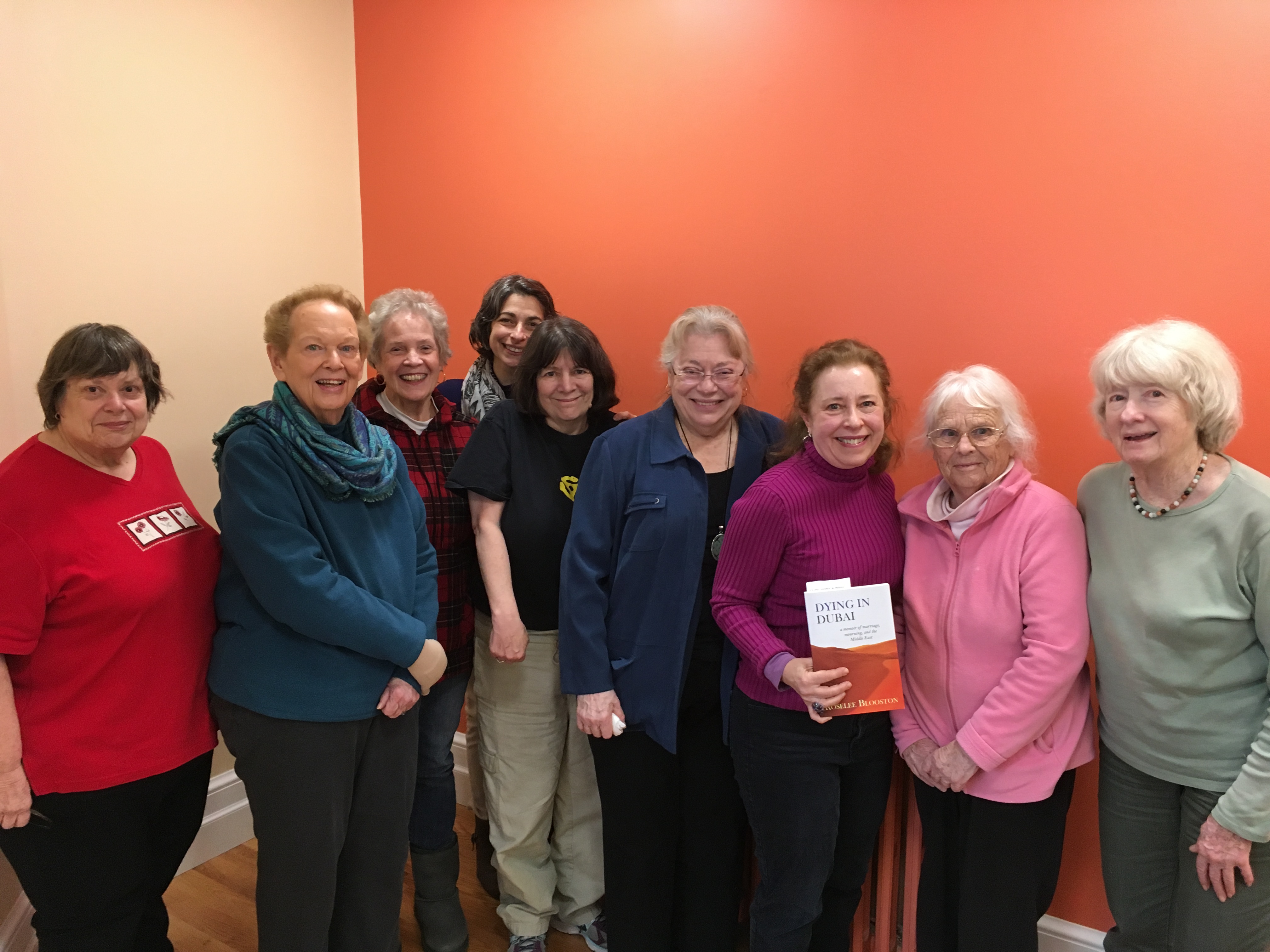
At each meeting, there are the expected questions readers ask:

  • Why did you write the book? (Because I had to.)
  • Was it hard to relive your experience on the page? (Yes and no. Very early on, it became more a matter of craft than of PTSD.)
  • Was it cathartic? (Yes, but only once the book was published.)
  • What did your family think? (They liked it, didn’t read it, or see above*)
  • What’s next for you? (Another book)

And the surprising ones:

  • Do you think your husband would have approved of the book? (Yes, I’m sure he would have. Jerry was my biggest fan.)
  • Are you dating again? (No, but I’m open…)

The most surprising reaction has been that of my two closest friends, both of whom have known me for decades. Both have struggled with absorbing my experience in book form, perhaps because they were part of it; it seems to be as emotional for them to read as it was for me to write. I realize that they are also dealing with revelations in the memoir that I didn’t share with them, close as we were. This was a conscious choice on my part. I wanted everything that had happened to me to exist nakedly on the page and didn’t want to risk diluting the impact by the kind of processing girlfriends do. This slowed them down considerably. One still hasn’t finished reading….

In contrast, I’ve heard from many readers that “it was a page-turner,” “couldn’t put it down,” “wanted to finish it more than I wanted to eat supper.” (That one made me laugh!) There are widows who loved it, and married women, for whom my story is their worst nightmare, who were glad to read the upbeat ending. A number of readers said that they felt like they “knew my husband,” and recognized the deep connection between us. I was happy to know that I got my major point about the marriage across. Many who spoke to me remarked how much they loved Wali’s “big as the universe” metaphor for the grieving process, and some said that they passed it along to friends going through loss. Glad to hear it.

As 2016 winds down, I welcome more comments from anyone who reads my book. I’m keeping a book of reader responses, which I will treasure long into the future. I welcome yours, and look forward to the events and book group discussions I have scheduled for 2017. Bring it on!

Happy Reading and Happy New Year to all!


Author

It’s two weeks until my book launch and I feel tremendous anticipation about what is certainly a defining moment in my life—very much like the two other days in my past when my public identity changed: my wedding day at the bus stop where Jerry and I met, when I became a wife, and the day, almost exactly three years later, when I gave birth to our son, Oliver, and became a mother. The launch on October 1st in our old hometown, Montclair, New Jersey, marks the moment when my status as a writer transforms permanently into that of “author.” Though I’ve had stories, essays and articles published in journals, magazines and anthologies, as well as plays professionally produced—the theatrical equivalent of publication—the publication of my memoir brings me to an entirely different level of achievement. An author is a writer who has published a book, and with the publication of DYING IN DUBAI, I have met the definition.

I remind myself how momentous and satisfying the launch event will be, as I tick down my list of To Dos: check in with my publicist, contact libraries and bookstores to schedule more events, organize the receptions, plan my readings and remarks, test pens, practice my signature, and answer the all-important question: What am I going to wear? At least once a day, I have to stop and take a conscious deep breath, lest I become the author version of Bridezilla. I tell myself, it will work out fine—you deserve it—now enjoy it.

On a particularly trying day, when I wondered how I was going to get from here to there— I was so frazzled that I actually spelled my first name “Rosalie” in an email signature—I stumbled onto the website for my local Rhinebeck bookstore, Oblong Books & Music (near my new home in the Hudson Valley), where I will have a second launch on October 6th, I had meant to hit another link, but rather than immediately switch sites, I found myself mesmerized by their home-page sliders of upcoming events: Man Booker Prize finalist, Emma Donoghue, Oprah’s Super Soul Sunday fav, Elizabeth Lesser, Bright Lights, Big City legend, Jay McInerney…and me, Roselee Blooston. I had to watch the loop of their faces and names, before and after mine, three times, before I could begin to absorb its import. I wasn’t delusional. I knew my career existed on a far more modest plane than these heavyweights, but even so, each slider was the same size and style; in this simple, direct presentation, we were equals—peers—because we had something fundamental in common: we were all published authors promoting our new books.

I let out a sigh and sat back nodding. It felt good.

Book in Hand

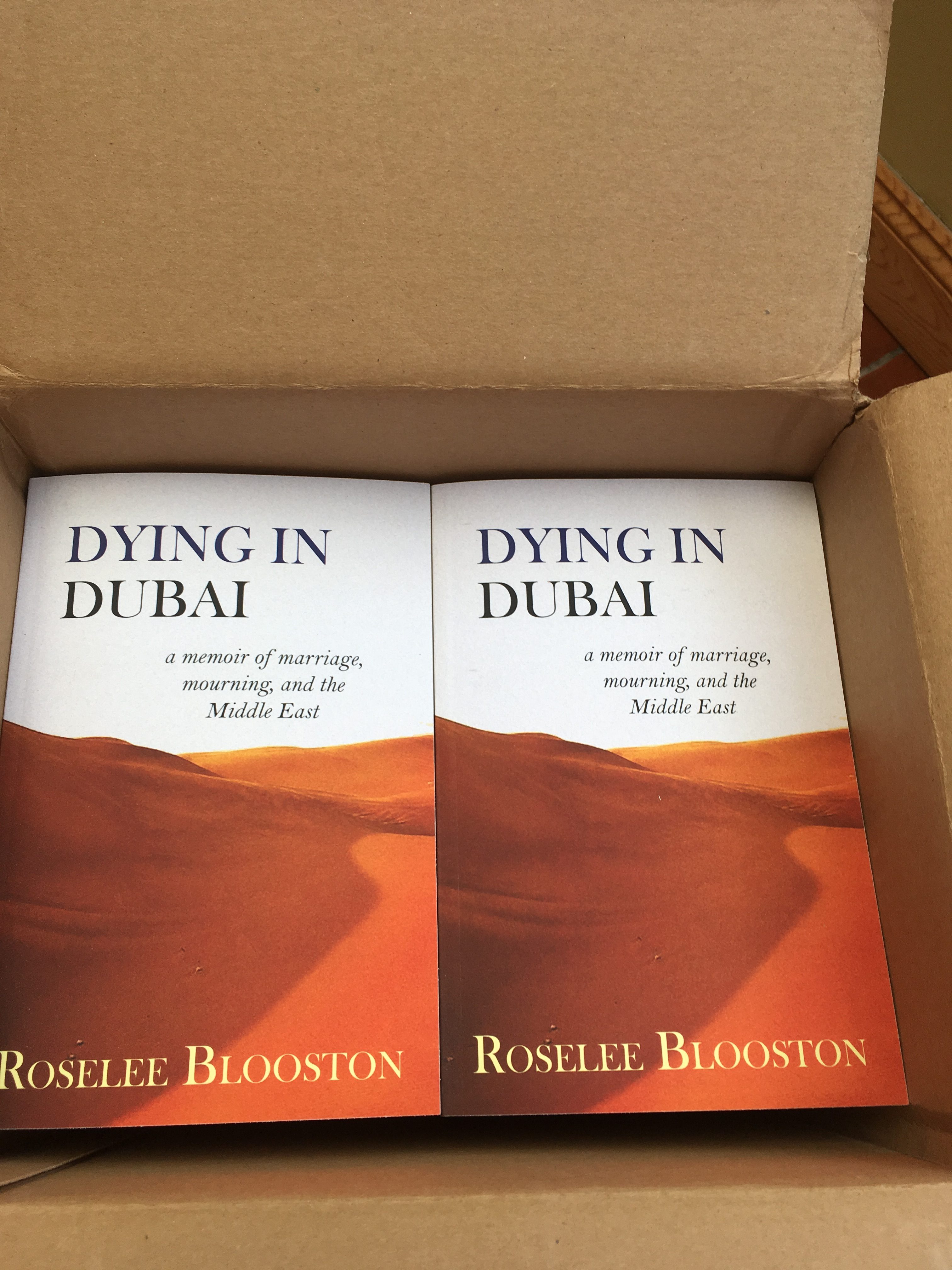
The ARCs have arrived!

Last week, when I contemplated writing this blog entry, I intended to title it, “Obstacles and Opportunities.” I often start with a title. My plays and my memoir, DYING IN DUBAI, began that way. Then two days ago, a box arrived, containing the Advance Review Copies of my memoir—ARCs, as they are known in the industry—and since that moment, and the one mere seconds after, when I sliced through tape and ripped open the cardboard top, to behold two stacks of “the book,” all thoughts of the eight plus years it took to get here, flew from my mind. In that moment, there was only the book in hand.

I stood alone, in my sunroom, staring down at the concrete manifestation of my long-awaited dream. The story of my grief and transformation that I had known from the outset could touch and help readers I would never meet, was now a reality, and I was both proud and stunned. For what felt like a long time, but may have been only a minute, I didn’t move. I drank in the cover, which of course I had seen on my screen many times, its three-dimensionality far superior to the flat image. Rarely is an imagined vision perfectly expressed. This was.

Gingerly, I lifted out a copy, careful not to bend the edges. I marveled at the size and weighed it, using my hand as scale. Solid. I inhaled the “new book” smell of freshly cut pages. I turned it over and admired the way the front cover’s sand and sky wrapped around to the back and how the blurbs, description, and my photo and bio all fit exactly as I had wished. Tentatively, at arms length, I flipped through the pages, congratulating my early insistence on cream stock—so much softer and easier on the eye than white—but I did not read. I still haven’t. I’m saving that experience for next week, or the week after. My publisher doesn’t need final changes until the end of July. Plenty of time to get used to the idea, to the fact, to the artifact of my labors stored in my study, and in that box. I have read thousands of books in my lifetime; next, I will read my own.

What do I think now about the obstacles that littered my path, but ultimately did not deter me: foremost among them, a two-year agent search and the nine months spent with one whose interest turned out to be tepid? I had thought that having an agent was the golden ticket, which was why I spent so long trying to land one, but learned instead that it’s better to have no agent than a bad agent, who would take 15% of any contract, even one I initiated. Weeks before I fired mine, sure that I would, I drew up a list of independent publishers I could approach without an agent. After a summer of re-grouping, I began again, on my own, and got an offer from the first publisher I applied to: a small, non-profit, university press. My goal had been to see the book published, not to self-publish. Years of solo performing, which sometimes involved self-producing, taught me that I needed the undeniable legitimacy of a curated process. The publisher said yes, they would be delighted to publish my memoir, and that was all the validation I needed. The agent had been a necessary obstacle, without which I would not have made my own opportunity.

Here I sit, at my desk, an ARC next to my computer, a solid, handsome volume containing my life and my work. Decades of performing gave me many euphoric moments, but life in the theater is all ephemera—by definition, it cannot last. The book exists, on its own, without me, and it could exist long after me. A writer friend pointed out that our books could end up in a yard sale that our grandchildren might come across someday. He meant it as a wonder, a legacy, a gratifying prospect. I agree.

So it is with joy and deep satisfaction, that finally, I hold my book in my hand.